
The Caribbean region is renowned for its diverse cultural heritage, stunning landscapes, and vibrant architecture, which reflect a blend of influences from indigenous peoples, colonial powers, and modern innovations. The table below presents a comprehensive comparison of various Caribbean house design styles.. Use it to help you decide the design style you want your next house to be.
| Design Style | Best For | Ventilation | Hurricane Resistance | Materials | Cost Level | Aesthetic Vibe | Ideal Setting |
| Caribbean Vernacular | Traditional Local Architecture | Excellent (Open window, cross breeze) | Moderate (light materials) | Timber, limestone, zinc | 💰 Low-medium | Charming, colourful, heritage look | villages, hillsides, small town |
| Colonial (British, Spanish, French) | Historic elegance, solid structure | Very good (tall windows) | High (thick walls and strong roofs) | stone, stucco, hardwood | 💰💰 Medium – high | Grand, Stately, symmetrical | Estates, town, old neighbourhoods |
| Plantation Style | Large lots, family estates | Excellent open galleries | High (deep roofs, sturdy columns) | Brick, wood, tile | 💰💰 Medium – high | Classic, romantic, luxurious | Countryside plantations |
| Modern Tropical / Contemporary Caribbean | Modern homes, villas, resorts | Excellent (open concept, louvers) | Very high (engineered design) | Concrete, wood, glass | 💰💰💰 Medium – high | sleek, eco-luxury, minimalist | Coastal zones, urban areas |
| Mediterranean / Spanish Revival | Hot, dry, coastal areas | Good (courtyards) | Very high (masonry, tile roofs) | Stucco, clay tile, stone | 💰💰 Medium – high | Rustic romantic, resort feel | Coastal areas, hillsides |
| Bahamian / Coastal Cottage | Beachside or island living | Excellent (airy porches) | Moderate -high (metal roofs, stilts | Wood, metal, vinyl | 💰 Low – medium | Cheereful, relaxed, bright | Coastal towns, islands |
| Sustainable / Eco-Caribbean | Off-grid, eco-conscious builds | Excellent (natural flow) | High (modern engineering) | Recycle wood, concrete, bamboo | 💰💰 Medium – high | Natural, organic, modern | Forest, eco-resorts, mountain slopes |
Click the link to Download the table as a Pdf
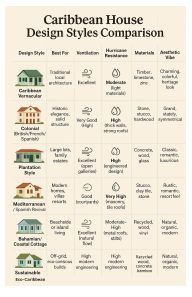
When comparing Caribbean house design styles, several key factors emerge that cater to different needs and preferences.
- For optimal airflow, the Caribbean Vernacular, Modern Tropical, and Bahamian styles excel, allowing breezes to circulate freely, which is essential in the warm climate.
- In terms of hurricane resistance, the Mediterranean, Modern Tropical, and Plantation styles stand out, designed to withstand severe weather conditions.
- For those prioritizing sustainability, the Sustainable or Eco-Caribbean style offers the most eco-friendly option, utilizing materials and designs that minimize environmental impact.
- Budget–conscious homeowners may find the Caribbean Vernacular and Bahamian styles to be the most affordable,
- While those seeking luxury might gravitate towards the Plantation and Contemporary Caribbean styles, which exude elegance and sophistication. Ultimately, each style offers unique benefits tailored to various lifestyles and preferences.
MORE ARTICLES
-

10 Ideas designed for a Caribbean Tropical Home
These ideas are designed for a Caribbean tropical home, where the emphasis is on natural materials, breezy spaces, vibrant foliage, and seasonal changes that fit the local climate rather than four distinct temperate seasons. 1. Tropical Spring Refresh To create a refreshing ambiance in a Caribbean tropical home, the concept of a “Tropical Spring Refresh”…
-

How to Make Your Own Bubble Diagram
A bubble diagram in architecture is a quick, loose way of planning how spaces relate to each other before you start drawing walls, doors, or exact dimensions. Think of it as the logic underneath the floor plan. Instead of drawing a bedroom as a precise 12′ × 14′ rectangle, you draw a bubble labelled Bedroom.…
-
Remedies for Slopes, Corners & Sharp Angles
In the realms of architecture and feng shui, a significant overlap exists in their fundamental principles, despite the different terminologies used. Feng shui emphasizes the concept of “chi,” which refers to the vital energy that flows through spaces, affecting the well-being of individuals. Architects, on the other hand, focus on aspects such as circulation, sight…